
The Client
The client, located in the Curitiba Industrial Zone, is one of Brazil’s premier poultry and beef deep-processing and export companies. As a critical node in the global food supply chain, the facility operates 24/7. To meet rigorous international sanitary standards, the plant undergoes daily disinfection using high-pressure steam and strong alkaline cleaning agents, placing extreme performance demands on all mobile logistics equipment.
The Challenges
In this high-intensity sanitation environment, standard industrial wheels proved unable to withstand the working conditions, manifesting the following critical issues:
Chemical Hydrolysis-Induced Failure: Under the combination of high-pressure steam and harsh alkaline agents, the molecular chains of standard polyurethane wheels break down rapidly. This causes the treads to soften, crack, and disintegrate within just three months.
Lipid Degradation & Debonding: Constant exposure to animal fats causes standard polyester-based polyurethane to swell. This leads to a loss of adhesion between the polyurethane tread and the metal hub, resulting in catastrophic debonding.
Secondary Infrastructure Damage: The degradation of the wheels resulted in abrasive movement, causing significant damage to the facility's expensive anti-microbial epoxy floor coatings and incurring substantial repair costs.
The Solutions
Following an on-site technical audit, we provided a customized "Food-Safe Mobility Solution":
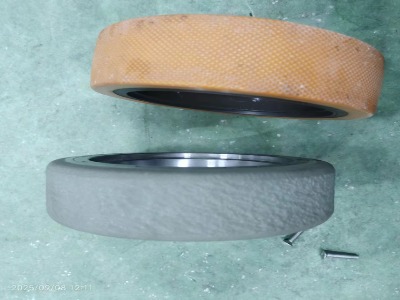
Polyether Elastomer Formulation: We utilized high-purity polyether prepolymers to replace traditional polyester. Polyether offers inherent water resistance at the molecular level, ensuring that the wheels maintain structural integrity and consistent hardness despite the humid climate and daily high-temperature washdowns.
Enhanced Stainless Steel Bonding Technology: To address the challenge of bonding polyurethane to 304 stainless steel, we implemented a multi-stage chemical pre-treatment process combined with a specialized food-grade primer. This ensures the bond strength exceeds the material's own tear strength, preventing debonding even when subjected to 80°C hot water rinsing.
H1-Grade Fully Sealed Protection System: The wheels feature fully shielded, double-sealed stainless steel ball bearings to physically block the ingress of blood, brine, and cleaning chemicals. Furthermore, we utilized NSF H1 food-grade grease to eliminate any safety risks to food production in the event of trace leakage.
The Results
The implementation of this high-performance solution significantly improved the client’s logistical efficiency:
Extended Service Life: The service life of the wheels increased from 3–5 months to over 18 months, with the units still in active, reliable operation.
Superior Durability: The solution successfully eliminated previous issues with debonding, cracking, and softening, maintaining a stable hardness of 95A even during high-temperature cleaning.
Maintenance Cost Reduction: By eliminating the need for frequent inspections and replacements, the facility reduced its total maintenance costs by over 65%.
Are you looking for an optimal mobility solution for your facility? Contact Our Technical Experts